Why India's Home Services Market Has No Playbook to Borrow
India's home services market gets talked about in the language of disruption - TAMs, penetration rates, category creation. All of that is real. But the more telling signal is a much simpler one.
TLDR
Bertelsmann India Investments (BII) on Why India's Home Services Market Has No Playbook to Borrow
- India’s home services market is not just being disrupted; it is being structurally formalized.
- Urban households are increasingly treating on-demand cleaning as a daily necessity rather than an occasional service.
- With only 20 to 50% of the $60 billion market digitized, there is significant room for growth across households, RWAs, and B2B use cases.
- Platforms like Snabbit can help institutionalize domestic work while creating pathways for greater women’s participation in the formal economy.
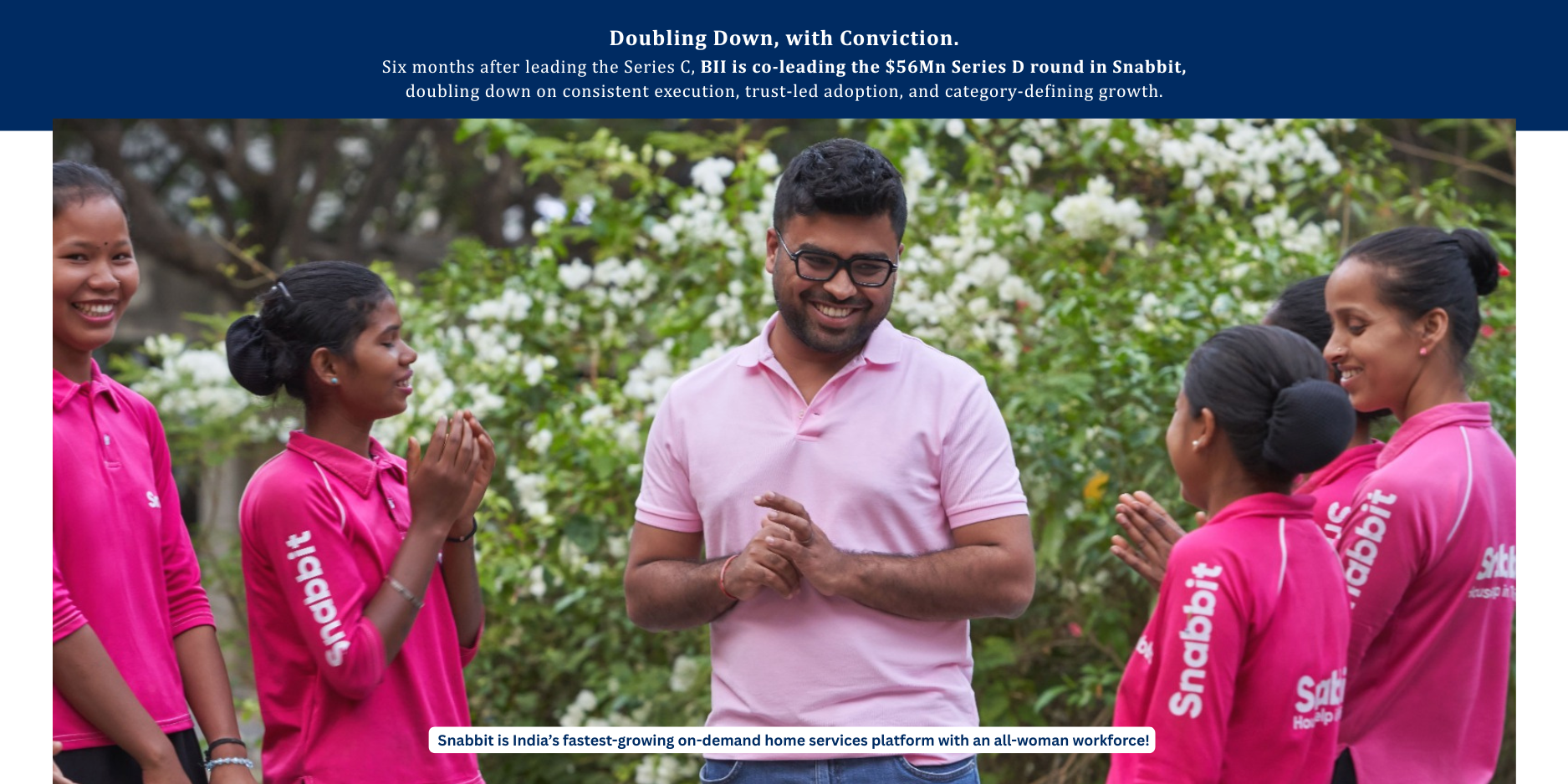
- Since BII’s investment, Snabbit has grown 10x from existing markets alone, showing strong depth and maturity in its micro-market model.
- BII’s balance-sheet-backed, long-term capital and partnerships make it well-suited for categories where growth compounds over years, not quarters.
A Cleaning App. A Care Economy. A GDP Story Nobody Is Telling.
By Team, Bertelsmann India Investments
India's home services market gets talked about in the language of disruption - TAMs, penetration rates, category creation. All of that is real. But the more telling signal is a much simpler one. It's the language. Urban households aren't saying 'our help didn't come so we had to book Snabbit.' They're saying 'we use Snabbit.' Present tense. Standing arrangement. The contingency became the default.
'India spends roughly $1 per day on home cleaning, every day' - This single fact, shared by Aayush (Founder, Snabbit), reframes everything. It isn't a product insight; it's a window into a quiet economic revolution. Because when you trace what happens as millions of households formalise something they've always done informally, the consequences reach well beyond a single company's growth curve. They show up in how Indian women work, how urban labour organises itself, and ultimately, in India's GDP. At BII, we backed Snabbit because we saw that bigger picture. This isn't just a company succeeding, it's an economic shift that's only just beginning to reveal itself.
India is not comparable to the West or any market that has ever existed
The comparison people reach for is quick commerce. It is correct in one dimension - low AOV, high frequency, daily habit - and completely wrong in another. India spends approximately $1 per day on home cleaning, every day. In the West, households self-clean and outsource only for periodic deep cleans. The frequency profile is fundamentally different. You cannot import a Western home services playbook into India because the typical Indian household has never existed in the West.
India's $60Bn home services market is less than 1% digitised today, and instant home services represent an even smaller fraction of that. India is not a laggard - it is a market at day zero, with a consumer behaviour (daily, paid, habitual cleaning) that no other market has at this frequency and price point. The structural enablers are unique: urban density, an informal workforce of 20–50 million domestic workers, rising dual-income households, and smartphone penetration that now reaches every income tier. India is not importing a playbook. It is writing one.
The B2B market hiding in plain sight
One layer of this opportunity hasn't received much attention yet: institutional demand. India has over 100,000 registered housing societies (RWAs) in major metros. A single 500-apartment society in Bengaluru or Mumbai can represent ₹50–75 lakh in annual home services spend. Co-living operators, corporate campuses, and serviced apartment operators represent a second organised demand channel — one with near-zero customer acquisition costs once a platform relationship is established.
Snabbit's hyperlocal nano-market model, built around density within a defined geography, is structurally identical to what institutional operators need. The unit economics become significantly more attractive: fewer cold customer acquisitions, predictable demand, and volume efficiencies for workers. A B2B distribution thesis for this category is still largely uncharted - and that, in itself, is part of what makes the opportunity compelling.
The demand-side social effects that change India’s GDP trajectory
India’s female labour force participation (FLFP) rate stands at 32.8% - among the lowest globally, and 18 percentage points below the world average (ILO, 2024). The NSO Time Use Survey (2019) found women spend 299 minutes per day on unpaid domestic work versus 97 minutes for men. Academic research consistently shows a 2-hour increase in unpaid care burden correlates with a measurable decrease in female formal employment.
When a dual-income household in Bandra or Whitefield eliminates the daily cognitive overhead of managing unreliable domestic help, two things happen. First, the household’s productivity rises. Second, the female member’s time and mental energy is partially freed for formal economic participation. This is an FLFP intervention at population scale — Goldman Sachs estimates full gender parity could add $770 billion - 18% of GDP - to India’s economy (Goldman Sachs, 2024).
“This is secondary income for a household, life-changing money, now earned spending even fewer hours at work.”— Aayush Agarwal, Founder & CEO, Snabbit
On the supply side: Snabbit’s all-female worker network earns ₹15,000–40,000 per month, on flexible schedules, with insurance and Aadhaar-linked bank accounts. The ILO estimates investment in India’s care economy could generate 69 million jobs by 2030. Snabbit is not adjacent to that story. It is that story.
Regulation is a moat, not a headwind
India's evolving gig worker regulation has been widely read as a cost. The Code on Social Security 2020 (implemented November 2025) requires aggregators to contribute 1–2% of annual turnover to a gig worker Social Security Fund, and Karnataka's operative ordinance adds a 1–5% welfare fee per transaction.
We read it differently. Informal domestic arrangements that are Snabbit's primary competition face the same compliance pressure with none of the infrastructure to absorb it. Snabbit already provides ₹6 lakh health insurance, Early Salary advances, digital payment rails, and Kavach safety infrastructure. Rather than a headwind, regulation accelerates the formalisation forcing function that makes platform adoption inevitable for every household that previously relied on informal help.
“Even when discounts go away, the prices won’t go up in any significant way because we don’t need to raise prices for this business model to be sustainable.”- Ayush, Snabbit
The behavioural data that proves habituation is real
The habit formation curve is the most underappreciated signal in this category. We are observing Snabbit process 40,000 jobs per day, in 140 active micro markets (Snabbit, Press Release). Urban Company’s DRHP provides the category-level baseline: its 2018 cohort deepened from 1.25 to 1.7+ service categories over time, with 79.9% user retention and 83.6% of NTV from repeat professionals. For Snabbit’s daily model, the curve is faster and steeper.
Daily cleaning, cooks, and childcare sit in the top-right quadrant of the frequency–spend matrix - the highest-frequency, repeat-use categories in India’s home services market. Once a household adopts the on-demand model, the switching cost is psychological, not contractual: the trust a verified worker earns by entering your home repeatedly is not easily transferred to a competing platform.
Since BII invested, Snabbit has grown 10x without adding new nano markets. All growth from existing market maturation alone.
I walked into the room curious and, to be honest, a bit skeptical. But I left deeply impressed and full of energy. In the weeks that followed, we observed extraordinary adoption all around us. Conversations with users and service providers reinforced our conviction that this is truly a category whose time has come.”— Rohit Sood, Partner, Bertelsmann India Investments
The market is debating whether Snabbit can sustain growth. We are watching structural signals compound simultaneously: India as the global template for domestic services formalization, an untapped B2B layer inside housing societies and co-living operators, a measurable FLFP impact on both sides of the market, a regulatory environment that will disproportionately benefit compliance-ready platforms, and behavioural habituation curves that deepen with every nano market that matures.
We are, as Aayush says, only scratching the surface.
SIGN UP FOR BLOG UPDATES
Related Post
WRITE FOR US
Join our community of guest bloggers today!
Stay informed. Stay inspired.
Sign up for our newsletter to get information on the latest venture capital insights and breakthroughs in the start-up world.
Post a Comment