India's Deep Tech Moment - How Patient Capital, Conviction, and Talent Are Converging
India is emerging as a global deep-tech powerhouse, driven by world-class talent, supportive policy, and founders solving complex problems at scale. Pankaj Makkar explores why patient capital and conviction will define the next decade of innovation.

For decades, the US and China have led the world in Deep Tech. India watched from a distance, supplying the engineers, running the R&D centers, doing the work. The value was created elsewhere.
That is changing. India is not just catching up. It has the ingredients to lead a world-class engineering talent pool, a government ecosystem actively backing innovation, and a generation of founders who have solved hard problems at scale. We are witnessing the emergence of India as the Next Deep Tech Capital of the World.
Talent Is the Thesis
India’s IT revolution happened because we combined low cost with high capability. The same combination is now powering a shift from low-end engineering work to high-end deep-tech innovation, and the results are beginning to show.
India produces up to 1.5 million engineering graduates annually and employs roughly 125,000 semiconductor design engineers - nearly 20% of the global chip design workforce. Global Capability Centres (GCC’s), once set up for back-office work, are now building products for global markets. Just as India’s SaaS companies like Zoho proved that world-class software could be built for global scale from India, the next generation of engineers is proving the same for Deep Tech.
Bertelsmann India Investments’ (BII) portfolio company Scimplify is a compelling example. Founded by an IIT Madras alumnus, it is reimagining how Specialty Chemicals, a global $800 billion industry, are developed and manufactured. With 50+ PhDs working on 200+ molecules annually across a network of specialized plants, Scimplify is giving pharmaceutical and agricultural companies a credible alternative to China-dependent supply chains, already serving customers across 16 countries.

ISRO is already a global benchmark for low-cost space innovation. IIT Madras has incubated over 500 startups in robotics, space, and semiconductors. Deep tech founders emerge from IITs, IISc, ISRO, and DRDO - institutions built to solve genuinely hard problems. India now has the talent base, and the track record, to build Deep Tech at scale.
India Is Now Building, Not Just Adopting
Policy is catching up with that talent. The National Quantum Mission launched with ₹6,003 crore. The India Semiconductor Mission is building a domestic chip ecosystem spanning design, fabrication, and packaging. The recently announced 1 lakh crore Research, Development and Innovation fund provides capital for research-driven companies.
Together, these represent a structural shift - from a country that adopted global technologies to one originating them. For entrepreneurs, that expands what can be built here. For investors, it creates the alignment that deep tech requires to scale.
Conviction Before Category
At BII, our approach has always been bottom-up. We start with founders solving meaningful problems, and then work to deeply understand the markets they are building in. We do not start with sectors.
But I will be honest: backing deep-tech companies has required us to extend that conviction further than usual. These are not businesses where you back a proven playbook. You are backing science, the team, and a belief that the technology will create a category that does not yet fully exist.
Our portfolio companies- Inito and SquadStack.AI show what that looks like in practice.
Inito sits at the intersection of Diagnostics and AI with a technology that allows smartphones to conduct hormone diagnostics from home —holding 20+ patents, a database of 30 million fertility hormone tests, and 50+ more patents pending, solving a global women’s health problem from India.
SquadStack has developed Voice AI models trained on 5,000 hours of data that have passed the Turing test, delivering an 80% reduction in costs versus traditional IVR spend - infrastructure that enterprises globally are adopting.
In each case, the moat is not the product alone. It is the depth of technology compounding underneath it. Deep tech ecosystems take time to mature and Bertelsmann, with its 180-year history of patient, long-term investing, is uniquely suited to back companies on exactly this journey.
Bharat Innovates Is the Bridge
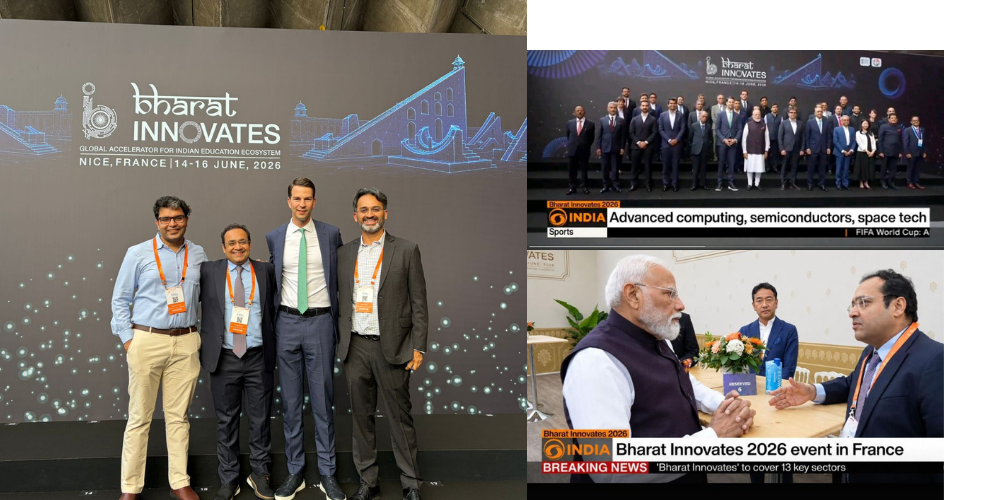
Capital alone does not build an ecosystem. It needs infrastructure — the kind that connects lab-stage innovation to global markets, and deep-tech founders to investors and partners who can take them further. That is precisely what Bharat Innovates is building. Organized by the Ministry of Education with strategic guidance from the Office of the Principal Scientific Adviser, it surfaces India’s most promising deep-tech ventures from its IITs, IISc, and CFTIs onto the global stage. The top 100 ventures will be showcased in France in June 2026. BII is proud to be a partner to that mission.
India’s Deep Tech Bet
Deep tech currently represents 10–12% of venture funding in India, against around 20% globally. A five to ten times expansion by 2035 is conservative if you believe, as I do, that India is not catching up to the global deep tech story. It is about to lead it.

India’s first startup chapter was built on digital platforms. The next will be defined by founders building deep technologies that shape global industries emerging from the same institutions that built India’s IT revolution, now solving for something far larger.
The ingredients are here. The conviction is here. That is the bet we are making.
Pankaj Makkar is Managing Director at Bertelsmann India Investments (BII), one of India’s leading early growth-stage venture funds.
<!--? echo set_value('description') ?-->
SIGN UP FOR BLOG UPDATES
Related Post


WRITE FOR US
Join our community of guest bloggers today!
Stay informed. Stay inspired.
Sign up for our newsletter to get information on the latest venture capital insights and breakthroughs in the start-up world.
Post a Comment