Celebrating Shiprocket’s IPO: A Decade of Building India’s E-Commerce Backbone!
Congratulations to Saahil, Gautam, Akshay and the entire Shiprocket team on the IPO! By Pankaj Makkar, Managing Director, Bertelsmann India Investments
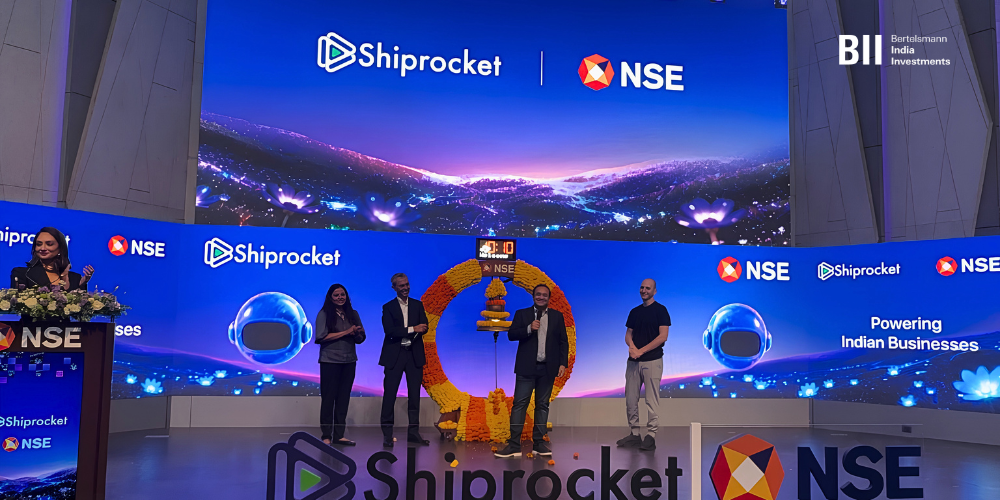

The NSE bell rang this morning, and Shiprocket is a public company.
There are only a few moments in this profession better than this one. We first backed Shiprocket in 2015, when a small merchant in India still could not reliably get a parcel across the country, and watching the Shiprocket team ring the IPO bell ten years later has been one of the great privileges of my working life. Congratulations to Saahil, Gautam, Akshay, Vishesh and every person who built this business - and to the four lakh businesses who trusted a young platform with their orders long before any of this looked inevitable.
What the company has built is India’s only and leading e-commerce enablement stack for small merchants and D2C Brands - assembled one layer at a time, over a decade, in an order almost nobody else in the world has attempted. That’s the achievement worth celebrating today because this e-commerce stack is not copied from a global company BUT has been built grounds-up, keeping in mind the requirements of our Merchants in India.
Fifteen contracts, or One – Start of the Enablement Journey
Picture a small business in Patiala in 2015: someone making phulkari dupattas, good enough to sell anywhere in the country. Building a website took an afternoon. Selling to Ludhiana was easy. Selling to Chennai was where the whole thing came apart.
No single courier covered India well, so reaching across the country meant contracts with roughly fifteen of them: fifteen negotiations, fifteen rate cards, fifteen sets of paperwork. The courier companies had little reason to pick up this small business owner’s phone. A merchant at that volume wasn’t worth a relationship, so she got whatever service and whatever rate was left over.
And even if all fifteen had said yes, she would have needed engineers to connect to fifteen different systems. Businesses that size don’t have engineering teams. They have one person doing everything. The market was there and she was ready. What was missing sat underneath both - infrastructure that had never been built with a business her size in mind.
My Partner at Bertelsmann, Rohit Sood, put it better than I can: Shiprocket is so unique, and so true to the Indian problem. There was no template for this. Not from the US, not from China. Nowhere else did the problem exist in that shape, which meant the answer had to be built from first principles or not at all.
Shiprocket’s answer to this had three parts, and each one is worth understanding separately. One integration instead of fifteen. Shiprocket integrated with every courier, then gave the merchant a single connection. One-time work, and suddenly you have a pan-India business.
Rates you couldn’t negotiate alone. Aggregate thousands of small merchants, the company could negotiate as a large shipper. Individually, none of them had leverage. Together, they did.
And then the part that turned out to matter most. Because every shipment across every courier ran through one platform, Shiprocket could see significant level of data insights as an aggregation platform – which the company used to build strong data products for it’s Merchant base. This type of Insights are only available to closed platforms like Amazon & Flipkart. Now imagine the small merchants & D2C brands getting the same power. This third capability wasn’t just a feature. It was the beginning of a data & tech business, and it’s where everything since has come from.
The decision to go all in
I’ll keep this part short, because it’s been told often enough.
In 2017 the founders were running a business that was working, and they shut it down to build this one instead. The metrics were fine. The reasoning was that they weren’t solving the biggest problem their merchants had.
We chose to fund that transition properly rather than cautiously, which I still think is the only defensible way to back a pivot. Incremental capital lowers the investor’s risk and the founder’s ceiling at the same time.
Saahil has described what that period felt like from his side:
“Bertelsmann allowed us to find our path, instead of typecasting us into a mould from day one. They made us think strategically about whether we had network effects, data scale, and plans for stopping encumbrance - basically, all the hard questions we needed to ask ourselves.”
The interesting part isn’t the decision. It’s everything that got built afterwards.
When the Data became the Product
Aggregation gave Shiprocket volume.
Volume gave it an unfair advantage (to build more tech products).
And that ecosystem-enablement platform became the MOAT.
The clearest example is RTO - Return to Origin, where a shipment goes out and comes back undelivered. It is the single most expensive problem in Indian e-commerce, and for years it produced the same argument on repeat: the merchant blames the courier, the courier blames the merchant, and nobody has neutral evidence.
Shiprocket sat in the middle of both sides. That position is unusual, and it meant the platform could do something neither party could do alone - look at the actual data and tell them what was true. Then it went further. Rather than just mediating disputes, Shiprocket started predicting failures before they happened. The RTO score gave merchants a read on which orders were likely to come back, before they shipped them.
The scale behind this now is significant. The parcel outcome models draw on more than 620 million transactions and 140 million end consumers. The risk and audience models sit on roughly 6.5 billion data points. The courier recommendation engine - the direct descendant of that Diwali routing decision, runs on approximately 10 billion data points for Fiscal 2026. In the first half of this fiscal (2026), the RTO product identified high-risk shipments with around 82
SIGN UP FOR BLOG UPDATES
Related Post
WRITE FOR US
Join our community of guest bloggers today!
Stay informed. Stay inspired.
Sign up for our newsletter to get information on the latest venture capital insights and breakthroughs in the start-up world.
Post a Comment